The Paraiba Tourmaline Mystery: From Brazil’s Neon Blue to the New African Treasures
The Birth of a Legend: The Rarest of Tourmalines
The history of gemstones was irrevocably changed in the late 1980s. In the Brazilian state of Paraíba, a passionate prospector named Heitor Barbosa mined continuously for seven years in a site nestled near the small town of São José da Batalha. In 1988, Barbosa’s tenacity was finally rewarded: he discovered the first crystals of a tourmaline endowed with a vibrant, exceptional color never before seen by humanity. Christened "Paraiba Tourmaline" in honor of its land of origin, it instantly established itself as the absolute queen of its mineral family.
What fascinates at first glance is its electric hue. Gemological analysis reveals the secret behind this visual signature: unlike other varieties, the Paraiba owes its incomparable neon glow to a unique composition, heightened by traces of copper and manganese that capture and reflect light in an almost surreal manner.
An Extraction of Infinite Patience
This collector's gem has always been, and remains today, extremely difficult to mine. To extract these precious crystals from the rock, countless galleries and deep tunnels—reaching up to 60 feet—were painstakingly dug. Following the initial discovery, exploration intensified, yet nature yielded her treasures only in trickles. The few rare gem veins discovered generally did not exceed an inch in thickness. At the peak of excavation until 1993, the neon blue Paraibas recovered weighed an average of a modest 1.5 grams, with only a few mythical specimens of 5 to 25 grams ever extracted.
By 1993, the main mine was unfortunately exhausted, leaving only three restricted sites in operation. Modern alluvial production requires colossal labor: no less than 4,000 tons of earth must be processed to hope for a yield of just 30 to 40 grams of rough tourmaline. Of this tiny amount, 75% will not meet jewelry-grade quality. Ultimately, only 7.5 to 10 grams of gem-quality stones are retained. Once faceted by the artisan, the final result is negligible in volume, yet of inestimable value.
The Elite of High Jewelry and the Soaring Market
Upon seeing these first stones, the perfection of their brilliance was such that many experts initially believed they were synthetic gems. It took rigorous expert reports from the GIA (Gemological Institute of America) to prove to the world that these neon blue shades were the exclusive work of nature.
The market's reaction was immediate: prices soared from $5,000 per carat to quickly reach and exceed $20,000 for the finest specimens. Its absolute rarity and the uncertainty regarding future production make it a prime investment for major collectors. The most illustrious Houses of Place Vendôme and beyond—from Tiffany & Co. to Chanel—rightly recognized its allure and have featured it at the heart of their most exclusive collections.
The African Epic: From Nigeria to Mozambique
Faced with the scarcity of the Brazilian mines, nature revealed new secrets in the early 2000s on the African continent. First, copper-bearing tourmalines with magnificent hues were discovered in Nigeria. Then, in the mid-2000s, Mozambique (notably the Mavuco region) literally revolutionized the market by offering crystals of remarkable purity, allowing for the faceting of larger carat gems. The GIA and leading global laboratories subsequently validated that these African stones, sharing the same copper and manganese chemical signature, fully merit the commercial designation of "Paraiba Tourmaline."
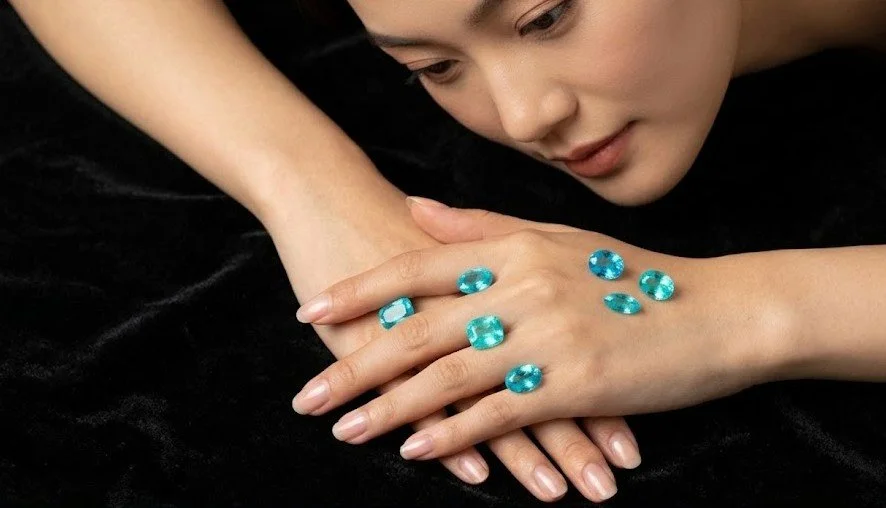
Neon glow revealed: a selection of faceted Paraiba tourmalines, originating from Brazil and Mozambique
The Event: The Emergence of a New Deposit in Ethiopia
As collector pieces from Mozambique and Brazil become increasingly scarce, the Earth has just offered us an extraordinary surprise. A brand-new deposit of copper-bearing tourmalines has just appeared in Ethiopia.
This major discovery is shaking the world of gemology by offering crystals of magnificent clarity and color saturation that rival the finest historical pieces. True to our promise of unearthing the exceptional, the House of Les Pierres Précieuses is privileged to announce that we will very soon be offering an exclusive selection of these new Ethiopian Paraibas on our online boutique. A rare opportunity for connoisseurs and investors alike to stay ahead of the market.
